
If you use a CNC milling machine, machining center or CNC router, there is a good chance you have already worked with an ER collet.
ER collets are widely used to hold cutting tools such as end mills, drills and router bits. Their popularity comes from a relatively simple design: one collet chuck can work with different tool shank diameters simply by changing the collet.
But ER11, ER16, ER20, ER25 and ER32 are not interchangeable, and choosing a larger collet is not always better.
This guide explains what an ER collet is, how the ER collet system works, the differences between common ER sizes, and what to consider when choosing one for a CNC application.
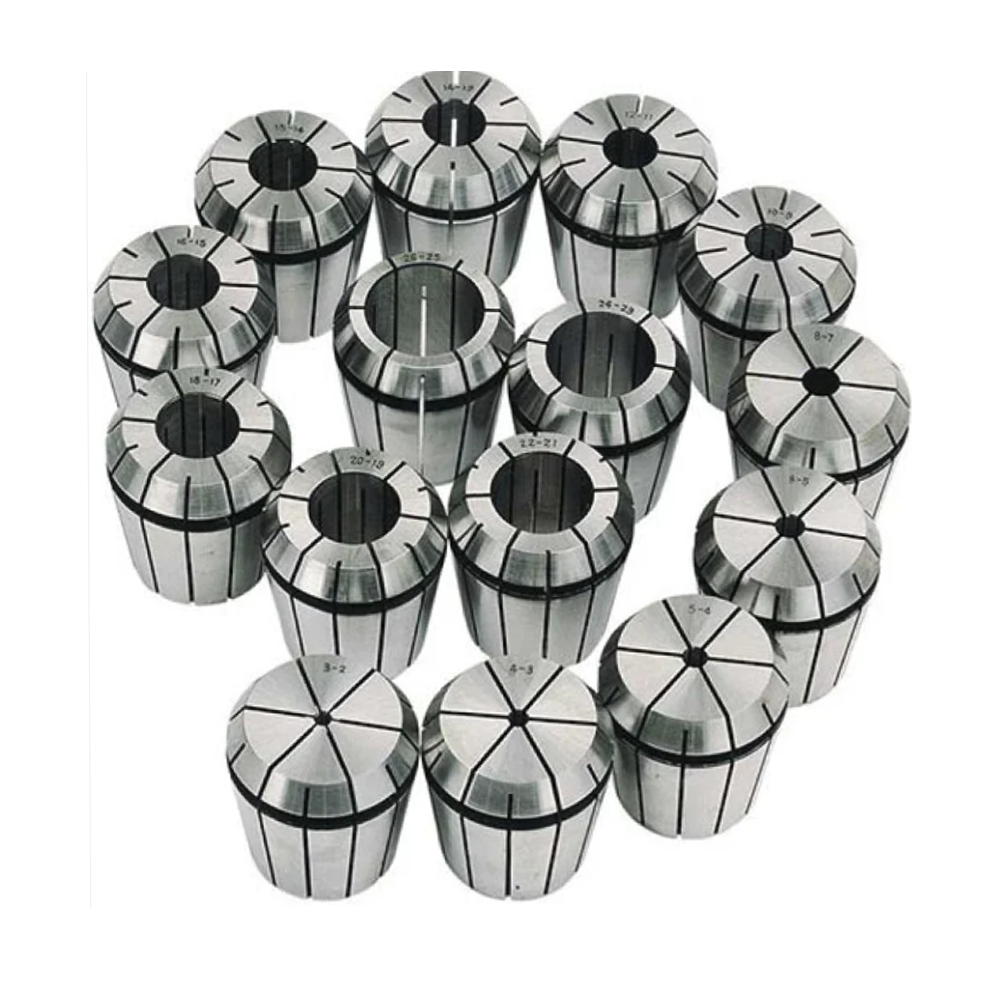
What Is an ER Collet?
An ER collet is a slotted, spring-type tool-holding component used to clamp the shank of a cutting tool inside an ER collet chuck.
The system normally consists of three main parts:
- ER collet chuck
- ER collet
- Collet nut
When the nut is tightened, the collet is compressed into the tapered seat of the chuck. This compression causes the collet to grip the tool shank around its circumference.
Unlike a fixed-size tool holder, an ER collet has a limited collapse range. This means one collet can accommodate a small range of tool shank diameters rather than only one exact diameter.
ER-style collet systems are standardized under ISO 15488, which covers collets with an 8° setting angle for cylindrical tool shanks, together with their corresponding holders and nuts. For the official specification, refer to the ISO 15488 standard.
For example, instead of replacing the complete holder every time the tool diameter changes, the operator can often keep the same ER chuck and install another collet from the same ER series.
This flexibility is one reason ER systems are commonly found on CNC routers, milling machines, machining centers and other machine tools.
How Does an ER Collet Work?
An ER collet has multiple slots running along its body. These slots allow the collet to compress evenly as it is drawn into the taper of the chuck.
The basic clamping process is straightforward:
- The ER collet is fitted into the collet nut.
- The cutting tool is inserted into the collet.
- The nut is threaded onto the collet chuck.
- Tightening the nut draws the collet into the tapered chuck.
- The collet contracts and grips the tool shank.
Because the clamping force is distributed around the tool shank, a correctly installed ER system can provide secure and relatively concentric tool holding.
However, performance depends on more than the collet itself. The condition of the chuck, nut, tool shank, taper surfaces and correct tightening procedure can all affect runout and holding performance.
Common ER Collet Sizes
ER collets are available in several standard series. Among the most commonly used are ER11, ER16, ER20, ER25 and ER32.
The number does not represent the tool diameter. It identifies the ER series and therefore the physical dimensions and approximate clamping capacity of the collet system.
A general comparison is shown below:
| ER Series | Maximum Clamping Size | Typical Applications |
|---|---|---|
| ER11 | Up to 8 mm | Engraving, small CNC spindles, precision tools |
| ER16 | Up to 12 mm | Light CNC routing, drilling and small milling |
| ER20 | Up to 15 mm | General CNC milling and routing |
| ER25 | Up to 20 mm | Medium-size cutting tools and milling applications |
| ER32 | Up to 22 mm | Larger tools and general-purpose CNC machining |
These values describe the overall capacity of each ER series. Individual collets within a series are supplied in different nominal sizes and clamping ranges.
For detailed dimensions and available individual sizes, see our ER collet size chart and specifications.
ER11 vs ER16 vs ER20 vs ER25 vs ER32
Choosing an ER series is mainly a balance between tool size, spindle or holder compatibility, available working space and the type of machining being performed.
ER11
ER11 is compact and commonly used with small-diameter cutting tools.
Its small physical size makes it useful where spindle dimensions and working clearance are limited. Typical applications include engraving machines, compact CNC routers and small high-speed spindles.
Maximum clamping capacity is approximately 8 mm.
ER16
ER16 provides more capacity than ER11 while remaining relatively compact.
It is often used for engraving, drilling, light routing and smaller milling tools. For machines that need more flexibility than ER11 without moving to a significantly larger holder, ER16 can be a practical choice.
Maximum clamping capacity is approximately 12 mm.
ER20
ER20 sits in the middle of the common ER range and is a versatile option for general CNC work.
It can accommodate a wider range of cutting tools while remaining smaller than ER25 and ER32 systems. It is commonly found in CNC milling and routing applications.
Maximum clamping capacity is approximately 15 mm.
ER25
ER25 is suitable when larger tool shanks need to be accommodated.
Compared with ER20, the system is physically larger but offers greater clamping capacity. It can be used for medium-size milling cutters and other CNC tooling where additional capacity is required.
Maximum clamping capacity is approximately 20 mm.
ER32
ER32 is one of the most widely used larger ER systems for general CNC machining.
Its wider size range makes it suitable for workshops that use many different tool diameters. The trade-off is that the collet, nut and holder are physically larger than smaller ER systems.
Maximum clamping capacity is approximately 22 mm.
How to Choose the Right ER Collet Size
The first question should not be “Which ER collet is best?”
Instead, ask:
Which ER collet system matches my machine and the tools I actually use?
There are several factors to consider.
1. Tool Shank Diameter
Start with the shank diameter of the cutting tool.
The selected collet must have a clamping range that correctly covers that diameter. Avoid forcing a tool into an undersized collet or excessively collapsing a collet beyond its intended range.
2. Existing Collet Chuck
An ER11 collet belongs in an ER11 chuck, an ER20 collet belongs in an ER20 chuck, and so on.
If your machine already has an ER chuck, identify its series before purchasing replacement collets.
3. Range of Tools Used
Consider the smallest and largest tool shanks you regularly use.
A workshop using mostly small engraving cutters may have little reason to install a large ER32 system. Conversely, a machine that frequently uses larger milling cutters may find ER11 or ER16 too restrictive.
4. Machine and Spindle Size
Smaller CNC spindles often use smaller ER systems because of physical space, spindle design and operating requirements.
Larger machining equipment can accommodate larger holders and collets.
5. Working Clearance
A larger ER system also means a larger nut and holder diameter.
When machining close to fixtures, workpiece walls or other restricted areas, this additional size can affect tool access.
For this reason, choosing the largest possible ER series is not automatically the best solution.
If you are unsure which ER series fits your machine, see our ER11, ER16, ER20, ER25 and ER32 comparison guide for differences in clamping range, tool size and typical CNC applications.
What Are ER Collets Used For?
ER collets are primarily used for holding round-shank cutting tools.
Common examples include:
- End mills
- Drills
- Engraving cutters
- Router bits
- Reamers
- Other round-shank CNC cutting tools
You can find ER systems in several types of equipment.
CNC Milling Machines
ER collet chucks allow operators to use multiple cutter diameters while keeping the same basic holder system.
CNC Routers
ER11, ER16 and ER20 are particularly common on smaller and medium-size CNC router spindles.
Machining Centers
Larger ER systems can be combined with machine tool holders for flexible tool holding across different machining operations.
Engraving Machines
Compact ER systems work well with the small-diameter cutters typically used for engraving and detailed machining.
What Affects ER Collet Runout?
Choosing the correct ER size is only part of achieving accurate tool holding.
Runout can also be affected by:
- Collet manufacturing accuracy
- Wear or damage to the collet
- Dirt on the collet or chuck taper
- Condition of the collet chuck
- Condition and accuracy of the nut
- Tool shank quality
- Incorrect tool insertion
- Incorrect tightening torque
Before installing a collet, the contact surfaces should be clean and free from chips, oil contamination and damage.
A high-quality collet cannot fully compensate for a damaged chuck, contaminated taper or poor installation.
Proper collet selection is only one part of maintaining machining accuracy. Cleaning, assembly, tool overhang and tightening torque can also affect concentricity. See our guide to measuring and reducing ER collet runout for a practical troubleshooting process.
ER Collet vs Standard Fixed-Diameter Holder
One of the main advantages of an ER system is flexibility.
A fixed-diameter holder is designed around a specific tool shank size. An ER system allows the same chuck to work with multiple tool diameters by changing the collet.
This can reduce the number of complete holders required and make tool changes more convenient.
However, this does not mean an ER collet is the best holder for every machining operation. Specialized applications may require hydraulic chucks, shrink-fit holders or other tool-holding systems depending on rigidity, speed, accuracy and machining requirements.
ER systems remain popular because they offer a practical balance of versatility, availability and ease of use for a wide range of CNC applications.
Frequently Asked Questions
What does ER mean in ER collet?
ER refers to the standardized collet system developed from the original E-type collet design. Today, ER is widely used as the designation for this style of spring collet and its corresponding chuck system.
Is ER32 better than ER20?
Not necessarily.
ER32 provides a larger clamping range, but it is also physically larger. ER20 may be more appropriate for machines using smaller tools or where additional working clearance is important.
The right choice depends on the machine and application.
Can an ER collet hold different tool sizes?
Yes, within its specified collapse or clamping range.
However, the correct nominal collet should always be selected for the tool shank being held. A collet should not be excessively compressed simply to avoid changing to the correct size.
Are ER11, ER16 and ER32 interchangeable?
No.
Each ER series has different dimensions and must be used with the corresponding chuck and nut system.
Which ER collet should I use for CNC milling?
There is no single ER size for all CNC milling applications.
Smaller cutters may work well with ER16 or ER20 systems, while larger tool shanks may require ER25 or ER32. The machine spindle, holder and required tool range should determine the final selection.
Choosing ER Collets for Your CNC Tooling System
ER collets are simple components, but choosing the correct series and size has a direct effect on tool compatibility and everyday machining convenience.
Start with your machine’s existing chuck, identify the tool shank diameters you need to hold, and then select the appropriate ER series and individual collet sizes.
For buyers comparing dimensions, available sizes and specifications, EverSource provides ER11, ER16, ER20, ER25 and ER32 precision ER collets for CNC tool holding.
View ER Collet Sizes & Specifications
For sourcing requirements or questions about matching ER collets with your CNC tooling system, contact EverSource for additional product information or a quotation.