
Choosing between ER11, ER16, ER20, ER25 and ER32 is not simply a matter of selecting the largest collet available.
Each ER collet series is designed for a different range of tool diameters, spindle sizes and machining requirements.
If you are new to the ER system, learn more about what an ER collet is and how it works, including its basic design, sizes and common CNC applications.
A compact ER11 system may be ideal for engraving and small CNC routers, while ER32 is better suited to larger milling cutters and heavier machining applications.
For CNC users, machine builders and purchasing teams, selecting the correct ER collet size helps improve tool holding stability, reduce unnecessary spindle weight and ensure that the tool diameter matches the available clamping range.
This guide compares the most commonly used ER collet sizes and explains where each one is normally used.
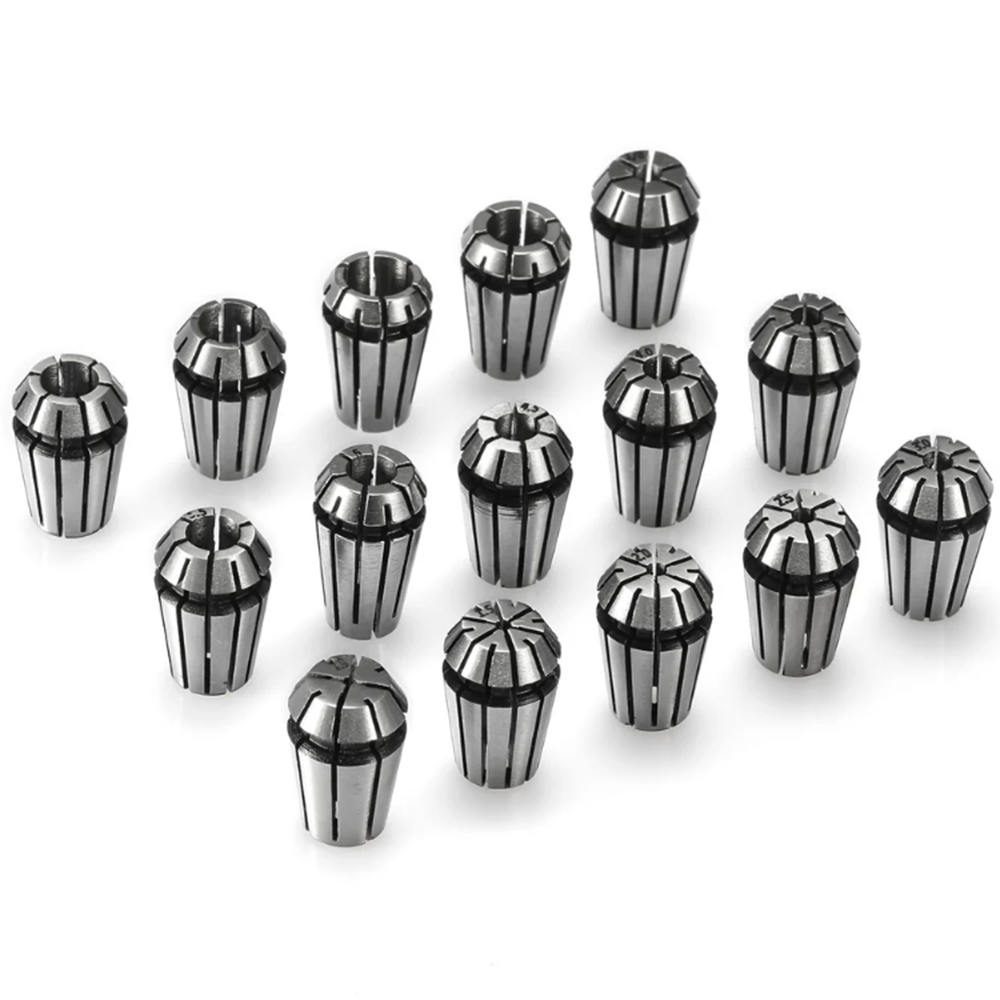
ER Collet Size Comparison at a Glance
The main difference between ER11, ER16, ER20, ER25 and ER32 is the physical size of the collet and the range of tool shank diameters it can accommodate.
| ER Series | Typical Maximum Clamping Diameter | Typical Applications |
|---|---|---|
| ER11 | Up to 8 mm | Engraving, PCB machining, compact CNC spindles |
| ER16 | Up to 12 mm | Light milling, CNC routing, engraving |
| ER20 | Up to 15 mm | General CNC milling and routing |
| ER25 | Up to 20 mm | Medium-size milling tools and CNC machining |
| ER32 | Up to 22 mm | Larger cutting tools and general industrial CNC machining |
These values provide a practical overview, but the correct selection should also consider spindle configuration, cutter diameter, machining load and required rigidity.
For detailed available dimensions and individual collet sizes, refer to our ER collet size chart and specifications.
What Is the Difference Between ER11 and ER16?
ER11 and ER16 are commonly used on smaller CNC machines, engraving machines and compact spindle systems.
ER11
ER11 is one of the smallest commonly used ER collet systems.
It is particularly suitable for:
- PCB drilling
- CNC engraving
- Small-diameter end mills
- Compact CNC routers
- High-speed spindle applications
- Fine machining tools
The maximum clamping diameter is typically around 8 mm.
Because the collet and nut are relatively compact, ER11 can help reduce the overall size and weight of the tool-holding assembly. This makes it useful where spindle space is limited or high rotational speeds are required.
The trade-off is that ER11 cannot accommodate larger tool shanks.
If your machine regularly uses 10 mm or 12 mm tools, ER11 will normally be too small.
ER16
ER16 provides a wider clamping range while remaining relatively compact.
It is commonly used for:
- Light-duty CNC milling
- Wood routing
- Engraving
- Small machining centers
- Compact CNC routers
- General-purpose small cutting tools
ER16 typically supports tool shanks up to approximately 12 mm.
For users choosing between ER11 and ER16, the most important question is usually tool diameter.
If most tools are below 8 mm and spindle compactness is important, ER11 may be sufficient.
If you need more flexibility and expect to use tools up to 10–12 mm, ER16 is generally the more practical choice.
ER16 vs ER20: Which One Should You Choose?
ER16 and ER20 overlap in many light and medium CNC applications.
The difference is mainly flexibility and tool capacity.
ER16 remains compact and is suitable for smaller tools. ER20 offers a larger clamping range, typically reaching approximately 15 mm.
ER20 is therefore commonly selected when a CNC machine needs to accommodate a wider variety of end mills, drills or router bits without moving to a significantly larger tool-holder system.
Typical ER20 applications include:
- CNC milling
- CNC routing
- General machining
- Drilling
- Woodworking
- Light metalworking
- Multi-purpose CNC machines
If your machine uses only small tools, ER16 may be more compact and economical.
If you regularly change between different cutter diameters and want additional flexibility, ER20 often provides a better balance between size and capacity.
ER20 vs ER25
Moving from ER20 to ER25 gives the user access to larger tool diameters.
ER25 typically supports tool shanks up to approximately 20 mm, making it useful for medium-size CNC cutters and machining operations requiring greater holding capacity.
ER25 is commonly used for:
- Medium-size milling cutters
- CNC machining centers
- Larger router bits
- General metalworking
- Medium-duty machining
- Machines requiring a broader tool range
Compared with ER20, the ER25 collet, nut and tool holder are physically larger.
This means ER25 is not automatically better simply because it supports larger tools.
For a machine that mostly runs 3 mm, 6 mm or 8 mm cutters, an ER20 system may already provide sufficient capacity.
However, if the tool list regularly includes 16 mm or 20 mm shanks, ER25 becomes a more appropriate choice.
ER25 vs ER32
ER32 is one of the most widely used ER collet sizes for general industrial CNC machining.
Compared with ER25, it provides additional capacity and is frequently used with larger cutting tools.
Typical ER32 applications include:
- CNC milling machines
- Machining centers
- Larger end mills
- Drilling applications
- Industrial routers
- General production machining
- Tool holders requiring a wide clamping range
ER32 typically supports tool shanks up to approximately 22 mm.
The major advantage of ER32 is versatility.
A single ER32 tool-holder system can support a broad range of cutter diameters, making it attractive for workshops that use many different tools.
However, ER32 is physically larger than ER11, ER16 or ER20.
On small CNC routers or compact high-speed spindles, the additional size and mass may be unnecessary.
Therefore, ER32 is generally more suitable for machines designed for medium or larger cutting tools rather than precision engraving or very small spindle assemblies.
Does a Larger ER Collet Provide Better Accuracy?
Not necessarily.
ER collet size and collet accuracy are two different factors.
Choosing ER32 instead of ER16 does not automatically improve runout or machining precision.
Accuracy depends on factors such as:
- Collet manufacturing tolerance
- Tool holder quality
- Spindle condition
- Collet nut quality
- Correct installation
- Cleanliness of the taper and collet
- Proper tightening torque
- Tool shank condition
A high-quality ER16 system can provide better tool runout performance than a low-quality ER32 system.
The correct approach is to choose an ER series that matches the required tool diameter and then select the appropriate precision grade for the machining requirement.
If you are sourcing precision ER collets for CNC tool holding, both dimensional compatibility and runout tolerance should be considered.
How to Choose the Correct ER Collet Size
When comparing ER11, ER16, ER20, ER25 and ER32, consider the following factors.
1. Check the Largest Tool Shank Diameter
Start with the largest cutting tool you expect to use.
For example:
- Tools up to 6–8 mm: ER11 may be sufficient
- Tools up to 10–12 mm: consider ER16
- Tools up to approximately 15 mm: ER20
- Tools up to approximately 20 mm: ER25
- Tools up to approximately 22 mm: ER32
You do not normally need to select a much larger collet system if your machine never uses large tools.
2. Consider the Spindle and Tool Holder
The spindle or tool holder must be designed for the corresponding ER series.
An ER16 collet cannot simply be installed in an ER20 holder.
The collet, nut and holder must belong to the same ER system.
Before purchasing replacement collets, verify the existing tool-holder designation.
3. Consider the Type of Machining
Small-diameter engraving tools have very different requirements from large milling cutters.
ER11 and ER16 are commonly associated with smaller tools and compact spindle systems.
ER20 provides a useful middle ground for many CNC routers and milling applications.
ER25 and ER32 provide increased capacity for larger tools and industrial machining.
4. Consider Machine Rigidity
Using a larger ER system does not increase the rigidity of the entire machine.
A small CNC router with limited spindle power will not necessarily benefit from an oversized ER32 tool holder.
The ER system should match the spindle power, machine frame and intended cutting load.
5. Consider Your Complete Tool Range
Do not choose a collet system based on only one cutter.
Review the entire tool list.
If a workshop uses tools ranging from 3 mm to 12 mm, ER16 may provide sufficient coverage.
If tools frequently range from small diameters to 16–20 mm, ER25 may provide more flexibility.
For a production environment using a wide range of larger tools, ER32 may be more practical.
Can One ER Collet Hold Different Tool Sizes?
ER collets have a limited collapse range, which allows one collet to clamp a small range of diameters.
However, this does not mean a single collet should be used for every nearby tool size.
For best concentricity and clamping performance, the nominal collet size should be selected as close as possible to the actual tool shank diameter.
For example, if you regularly use a 6 mm tool, using the correct 6 mm ER collet is generally preferable to relying unnecessarily on the maximum collapse range of another size.
This becomes particularly important in applications where low runout and consistent tool positioning are required.
Which ER Collet Size Is Best for a CNC Router?
There is no universal answer because CNC routers vary significantly in spindle size and application.
For small desktop routers and engraving systems, ER11 or ER16 is common.
For general woodworking and medium-size CNC routers, ER20 is widely applicable.
For larger routers using bigger cutters, ER25 or ER32 may be more suitable.
The deciding factor should be the actual spindle specification and tool diameter range rather than the machine category alone.
Which ER Collet Size Is Best for CNC Milling?
For light milling and smaller cutters, ER16 or ER20 may provide sufficient capacity.
For broader general-purpose milling applications, ER25 and ER32 offer larger tool ranges.
ER32 is especially useful where multiple cutter diameters need to be supported from one tool-holder platform.
However, precision milling still depends heavily on collet quality, tool-holder condition and spindle runout.
Therefore, selecting the largest available ER system is not a substitute for selecting a high-quality precision collet.
ER11 vs ER16 vs ER20 vs ER25 vs ER32: Final Selection Guide
A simple way to choose is to match the ER series to the largest tool diameter your machine realistically needs.
Choose ER11 if:
you mainly use small engraving tools, PCB tools or cutters below approximately 8 mm.
Choose ER16 if:
you need a compact system but want greater flexibility for tools up to approximately 12 mm.
Choose ER20 if:
you need a versatile option for general CNC routing and milling with tools up to approximately 15 mm.
Choose ER25 if:
your machine regularly uses medium-size tools and requires capacity up to approximately 20 mm.
Choose ER32 if:
you need a broad tool range, larger cutters and a general-purpose industrial CNC tool-holding system.
The correct ER collet is therefore not necessarily the largest one. It is the smallest practical ER series that safely covers your required tool range while matching the spindle and machining application.
After selecting the correct ER collet size, the complete assembly should still be checked for accuracy. Incorrect seating, contamination or excessive tool overhang may cause measurable runout even when the collet size is correct. Read how to diagnose and reduce ER collet runout.
View ER Collet Sizes and Specifications
EverSource supplies ER collets for a range of CNC machining and tool-holding applications, including ER11, ER16, ER20, ER25 and ER32 sizes.
You can view the available sizes, dimensions and product specifications on our ER Collet product page.
For assistance selecting the appropriate ER collet size or sourcing collets for your CNC application, contact EverSource with your required ER series, tool diameter and quantity.
learn more on our YouTube Channel: https://youtu.be/y6doZYvid10?si=Tfvqckh4sIuDIas_