
Fishtail vs upcut router bit
Choosing the right CNC router bit can make a significant difference in cutting accuracy, surface finish, chip evacuation, and tool performance. Whether you are machining wood, acrylic, plastics, or other industrial materials, understanding router bit geometry is essential for achieving consistent results.
Three terms commonly encountered when selecting CNC cutting tools are fishtail router bit, upcut router bit, and downcut router bit.
However, these terms do not describe exactly the same type of cutting tool feature.
A fishtail router bit is primarily identified by its distinctive cutting-tip geometry, while upcut and downcut router bits are generally classified according to their flute direction and chip movement.
Understanding this distinction helps CNC operators, manufacturers, and industrial buyers avoid selecting a tool based on terminology alone.
In this guide, we compare fishtail, upcut, and downcut router bits, explain their cutting characteristics, and discuss how to choose the right configuration for different CNC machining applications.
If you’re new to this cutting tool design, start with our detailed guide on what is a fishtail router bit, which explains its cutting-edge geometry, common CNC applications, and key considerations for precision routing.
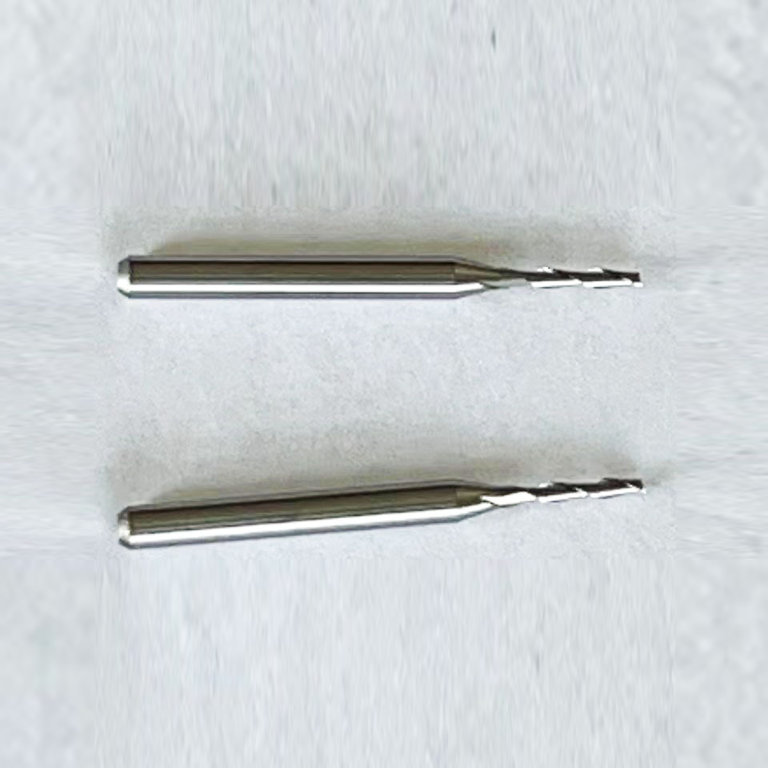
1. What Is a Fishtail Router Bit?
A fishtail router bit is a CNC cutting tool characterized by a specially shaped cutting edge at the tool tip.
Unlike a conventional flat-end cutting tool, its tip features a distinctive fishtail-style profile designed for specific routing and cutting operations.
Depending on the tool configuration, fishtail router bits can support controlled material entry, precision contouring, slotting, and profiling.
At Ever Source, our fishtail router bit range includes carbide cutting tools with cutting diameters from approximately 0.8 mm to 3.175 mm, providing options for small-diameter CNC routing applications.
These tools are presented for applications involving:
- CNC woodworking and engraving
- Acrylic and plastic processing
- Precision contour cutting
- PCB routing and profiling
- Selected soft-metal machining applications, subject to tool compatibility
One important consideration is that fishtail geometry alone does not determine how efficiently chips are removed from the cutting area.
Chip evacuation also depends on flute design, cutting parameters, workpiece material, and machine conditions.
For a detailed introduction to this tool type, see our previous guide, What Is a Fishtail Router Bit? Design, Uses and CNC Cutting Applications.
2. What Is an Upcut Router Bit?
An upcut router bit typically features spiral flutes designed to move chips upward, away from the cutting area.
As the tool rotates, its flute geometry encourages material removal toward the top of the workpiece.
This configuration is commonly used in CNC machining applications where chip evacuation is a priority.
Advantages of Upcut Router Bits
Efficient chip evacuation
The upward flute direction helps remove chips from grooves, slots, and deeper cutting paths.
Reduced chip accumulation
Removing chips from the cutting zone can help reduce recutting and improve cutting efficiency.
Suitable for deeper routing operations
Upcut tools are often selected for slotting and pocketing applications where chip clearance is important.
Good bottom-edge quality in suitable materials
In some woodworking applications, upcut geometry can produce a relatively clean bottom edge.
Limitations of Upcut Router Bits
The upward cutting action can lift wood fibers or laminated surface layers, potentially causing tear-out or chipping along the top edge.
For this reason, upcut router bits may not be the preferred option when the visible top surface requires a particularly clean finish.
The actual result depends on material structure, tool sharpness, cutting parameters, and workholding.
3. What Is a Downcut Router Bit?
A downcut router bit uses a spiral flute configuration that directs chips and cutting forces downward toward the workpiece.
This cutting action can help press the top surface fibers or laminated layers against the material.
As a result, downcut router bits are frequently used in applications where top-surface quality is particularly important.
Advantages of Downcut Router Bits
Cleaner top-surface finish
The downward cutting action can reduce lifting and tear-out of surface fibers in wood-based materials.
Suitable for laminated panels
Downcut tools are commonly considered for plywood, veneer, and laminated materials where surface appearance matters.
Reduced top-edge chipping
Under suitable conditions, downcut geometry helps maintain cleaner top edges during CNC routing.
Limitations of Downcut Router Bits
Because chips are directed downward, chip accumulation can become a problem in deep grooves or closed pockets.
This can increase cutting temperature, cause chip recutting, and negatively affect machining performance.
Downcut router bits may therefore require careful consideration of cutting depth, feed rate, chip clearance, and material properties.
For deep-slotting operations, an upcut or other suitable tool configuration may offer better chip removal.
4. Fishtail vs Upcut vs Downcut Router Bits: Key Differences
The most important distinction is that fishtail geometry and spiral cutting direction describe different aspects of a router bit.
A fishtail cutting edge refers to the geometry of the tool tip.
Upcut and downcut refer to the direction in which the spiral flutes move chips during cutting.
Therefore, a fishtail-style cutting tip and a particular flute direction are not necessarily mutually exclusive features.
The following table summarizes their main characteristics.
| Feature | Fishtail Router Bit | Upcut Router Bit | Downcut Router Bit |
|---|---|---|---|
| Main classification | Cutting-tip geometry | Upward spiral flute direction | Downward spiral flute direction |
| Primary characteristic | Distinctive tip profile | Moves chips upward | Directs chips downward |
| Chip evacuation | Depends on flute design | Generally effective upward evacuation | May accumulate chips in deep slots |
| Top-edge finish | Depends on complete tool geometry | Higher tear-out risk in some materials | Often cleaner in wood laminates |
| Bottom-edge finish | Depends on application | Often favorable in wood panels | May require more attention |
| Plunge cutting | Depends on center-cutting design | Depends on tip geometry | Depends on tip geometry |
| Typical applications | Precision routing and contouring | Slotting, pocketing, deep routing | Laminated panels and top-surface finishing |
No single router bit geometry is ideal for every machining operation.
The best choice depends on the material, cutting depth, edge-quality requirements, and CNC machine setup.
5. Which Router Bit Is Best for Different Materials?
Different workpiece materials respond differently to cutting forces, chip movement, and heat generation.
Selecting the right router bit requires understanding these characteristics.
CNC Woodworking and MDF
Wood, plywood, and MDF are widely processed using CNC routers.
For solid wood, chip evacuation and fiber tear-out are important considerations.
Upcut router bits can be useful when efficient chip removal is required, particularly for grooves and deeper routing operations.
Downcut router bits are often preferred when maintaining a clean top surface is important.
For precision profiling or engraving, a suitably designed fishtail router bit may also be considered.
However, the final selection should account for material density, surface coating, grain direction, and cutting depth.
Acrylic and Plastic Processing
Acrylic and engineering plastics require careful control of heat generation and chip removal.
Excessive cutting temperatures can cause melting, material adhesion, or poor edge quality.
For acrylic routing, a tool with suitable flute geometry and efficient chip evacuation is often advantageous.
Upcut configurations can help move chips away from the cutting zone, but the specific tool design must be suitable for the plastic being processed.
Fishtail router bits may also be used for precision acrylic or plastic routing when their cutting-edge geometry and operating parameters are appropriate.
When selecting a router bit for acrylic, buyers should consider:
- Cast versus extruded acrylic
- Material thickness
- Required edge quality
- Cutting diameter
- Flute count and geometry
- Feed rate and spindle speed
Plywood and Laminated Panels
Laminated materials are particularly sensitive to surface chipping.
When the top surface must remain clean, a downcut router bit may be preferred.
However, when both the top and bottom surfaces require high-quality edges, a compression router bit may be a more suitable option.
Compression router bits combine upward and downward cutting actions along different portions of the cutting edge.
They are commonly used in panel processing where minimizing chipping on both faces is important.
PCB Routing and Profiling
PCB routing involves additional considerations, including abrasive fiberglass reinforcement, small feature sizes, and dimensional accuracy.
Carbide cutting tools are commonly used because of their hardness and wear resistance.
For PCB applications, buyers should select tools specifically designed for the substrate and machining operation.
A general-purpose woodworking router bit should not automatically be considered suitable for PCB machining.
Small-diameter fishtail router bits may be appropriate for certain PCB profiling applications when their specifications are confirmed by the supplier.
6. How Does Router Bit Geometry Affect Cutting Performance?
Router bit geometry influences several important aspects of CNC machining.
Chip Evacuation
Efficient chip removal helps prevent recutting, overheating, and material buildup.
Upcut spiral tools generally provide a clear upward chip-removal path.
Downcut tools move chips downward and may require additional attention to chip clearance in deeper cutting operations.
Fishtail router bits must be evaluated according to their actual flute configuration rather than tip geometry alone.
Surface Finish
Surface quality depends on how the cutting edge interacts with the workpiece.
Upcut tools may lift fibers on the top surface of wood-based materials.
Downcut tools can reduce this lifting effect.
Fishtail tools may provide accurate cutting performance, but their surface finish depends on cutting-edge geometry, tool condition, machining parameters, and material characteristics.
Cutting Stability
Cutting stability is influenced by tool diameter, cutting length, overall length, rigidity, and machine setup.
Smaller-diameter tools are useful for detailed features but can be more susceptible to deflection.
Long tool overhang can also increase vibration and reduce machining accuracy.
For industrial CNC operations, selecting the correct tool dimensions is just as important as selecting the cutting geometry.
7. How to Choose the Right CNC Router Bit for Your Application
Industrial buyers should evaluate several factors before ordering CNC router bits.
Step 1: Identify the Workpiece Material
Start by specifying the exact material.
For example, acrylic, MDF, plywood, PVC, ABS, and fiberglass-reinforced PCB substrates have different machining requirements.
Step 2: Define the Cutting Operation
Determine whether the tool will be used for:
- Contour cutting
- Slotting
- Engraving
- Pocketing
- Profiling
- Plunge cutting
Different operations place different demands on the cutting edge and flute design.
Step 3: Determine Surface-Finish Requirements
Consider whether the top edge, bottom edge, or both surfaces must meet specific quality requirements.
For laminated panels, surface finish may be more important than maximum chip evacuation.
For deeper slots, efficient chip removal may take priority.
Step 4: Select the Appropriate Tool Dimensions
Tool dimensions should match the required cutting width, machining depth, and machine setup.
Ever Source’s fishtail router bit product range includes several cutting diameters and length configurations.
Buyers should verify the cutting diameter, shank diameter, cutting length, and overall length before ordering.
Step 5: Confirm Tool Compatibility
Finally, verify that the tool is compatible with the CNC spindle, collet, workpiece material, and intended cutting conditions.
For demanding applications, request technical guidance from the cutting tool supplier.
8. Ever Source Fishtail Router Bits for Precision CNC Routing
Ever Source supplies carbide cutting tools for industrial CNC machining applications.
Our fishtail router bit product range includes multiple diameter and length configurations designed for precision routing requirements.
The product page provides technical drawings, dimensional specifications, product photographs, and information about Ever Source’s production facilities and quality assurance.
For CNC workshops, industrial distributors, and equipment manufacturers, these details can help support preliminary tool selection and supplier evaluation.
When comparing fishtail, upcut, and downcut router bits, it is important to evaluate the complete tool design rather than relying on a single geometry description.
Explore our Fishtail Router Bit product range to review available configurations.
For specific machining requirements, contact Ever Source with your workpiece material, cutting dimensions, and CNC machine information.
For industrial CNC machining applications, explore Ever Source’s carbide fishtail router bits, available in multiple cutting diameters and length configurations. Review the product specifications and technical drawings to identify a suitable tool for your routing requirements.
Frequently Asked Questions
Is a fishtail router bit better than an upcut router bit?
Not necessarily. Fishtail refers primarily to cutting-tip geometry, while upcut describes flute direction. The best configuration depends on the machining operation, workpiece material, and required cutting performance.
What is the main difference between upcut and downcut router bits?
Upcut router bits move chips upward and generally provide effective chip evacuation. Downcut router bits direct chips downward and can help reduce top-surface tear-out in wood and laminated materials.
Which router bit produces the cleanest edge on plywood?
Downcut router bits can produce cleaner top edges, while upcut tools may provide better bottom-edge quality. Compression router bits are often considered when both surfaces require clean edges.
Can fishtail router bits be used for acrylic?
Yes, appropriately designed fishtail router bits may be used for acrylic machining. Tool selection should consider flute geometry, chip evacuation, cutting parameters, and the type of acrylic.
Are upcut router bits suitable for deep cutting?
Upcut router bits are often suitable for deeper slotting and pocketing because their flute geometry helps evacuate chips upward. However, cutting depth must still match the tool specifications and machining conditions.
What information should I provide when ordering CNC router bits?
Provide the workpiece material, cutting diameter, shank diameter, required cutting depth, machining operation, CNC spindle specifications, and surface-finish requirements.
Conclusion
Understanding the difference between fishtail, upcut, and downcut router bits is essential for selecting the right CNC cutting tool.
Fishtail geometry describes the cutting-tip profile, while upcut and downcut describe the direction of chip movement produced by the flute design.
Each configuration has advantages and limitations depending on the workpiece material and machining operation.
For industrial buyers, evaluating tool geometry, dimensions, material compatibility, and cutting requirements together provides a more reliable basis for tool selection.
Explore Ever Source’s carbide fishtail router bits and contact our team to discuss your CNC routing applications.