
Choosing the right milling cutter can make a significant difference in machining accuracy, surface finish, tool life, and production efficiency. While milling cutters may look similar at first glance, different cutter designs are made for very different operations—from cutting flat surfaces and slots to machining contours, profiles, and detailed 3D shapes.
For CNC users, the right choice depends on more than cutter diameter alone. The workpiece material, machining operation, cutting depth, machine rigidity, spindle capability, and required surface finish all influence which tool will perform best.
This guide explains the most common types of milling cutters, what they are used for, and the key factors to consider when choosing a cutter for CNC machining.
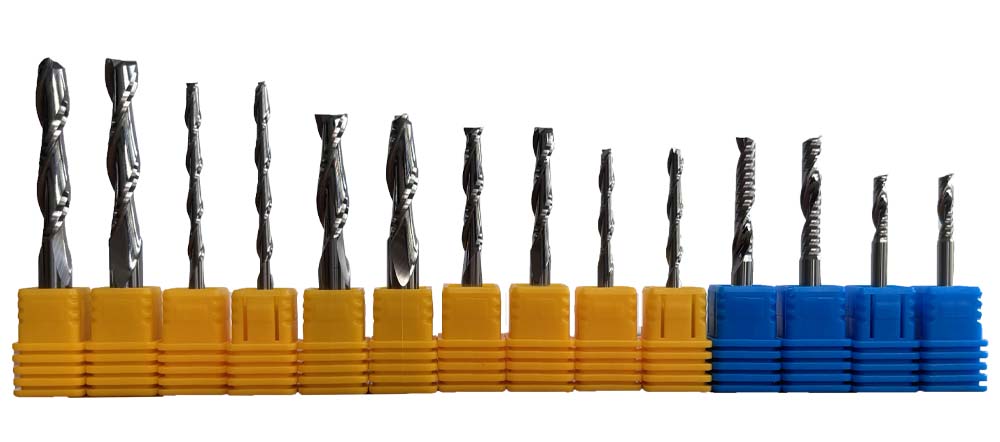
What Is a Milling Cutter?
A milling cutter is a rotating cutting tool used to remove material from a workpiece during a milling operation. As the cutter rotates, one or more cutting edges remove chips from the material to create the required shape, slot, surface, groove, or contour.
Milling cutters are widely used in CNC machining centers, milling machines, CNC routers, engraving machines, and other automated machining equipment.
Depending on the cutter design, milling tools can be used for:
- Flat surface machining
- Slotting and grooving
- Pocket machining
- Profiling and contouring
- Engraving
- Rough machining
- Finishing
- 3D surface machining
- Edge preparation
Because no single milling cutter is ideal for every operation, understanding the differences between cutter types is important before selecting a tool.
If you are unsure how an end mill differs from other milling cutters, read our guide to [Milling Cutter vs End Mill].
Common Types of Milling Cutters
1. End Mills
End mills are among the most commonly used milling cutters in CNC machining.
Unlike some cutters that mainly cut with their outer circumference, end mills can usually cut with both the end and the side of the tool. This makes them suitable for a wide range of operations.
Typical applications include:
- Slot cutting
- Pocket milling
- Side milling
- Profiling
- Contouring
- General CNC machining
End mills are available in different diameters, flute configurations, materials, coatings, and cutting geometries.
For general-purpose CNC work, the end mill is often one of the first cutter types considered.
2. Flat End Mills
A flat end mill, sometimes called a square end mill, has a flat cutting end and is commonly used when a flat-bottomed surface or a sharp internal corner is required.
Typical applications include:
- Flat-bottom slots
- Pockets
- Side walls
- Square shoulders
- General profile machining
Flat end mills are particularly useful when dimensional accuracy at the bottom of a pocket or slot is important.
They are widely used for machining metals, plastics, wood, composites, and other materials, depending on the cutter material and cutting geometry.
3. Ball Nose End Mills
A ball nose end mill has a rounded cutting end rather than a flat tip.
This shape makes it particularly suitable for curved surfaces and three-dimensional machining.
Common applications include:
- 3D contour machining
- Mold machining
- Curved surfaces
- Complex profiles
- Finishing operations
- Detailed CNC engraving
Ball nose cutters are often used when the required surface contains smooth curves rather than flat faces.
For complex three-dimensional work, a smaller step-over can improve the final surface finish, although it may also increase machining time.
4. Roughing End Mills
Roughing end mills are designed to remove material quickly during the early stages of machining.
Their cutting edges often feature a serrated or interrupted geometry that breaks chips into smaller pieces and reduces cutting resistance.
Typical uses include:
- Heavy material removal
- Initial pocket machining
- Rough profiling
- Preparing a workpiece before finishing
A roughing cutter is generally selected when productivity and material removal rate are more important than achieving the final surface finish in a single pass.
After rough machining, a finishing cutter can be used to achieve the required dimensional accuracy and surface quality.
5. Face Milling Cutters
Face milling cutters are primarily designed to machine large flat surfaces.
Instead of using a small-diameter cutter to make repeated passes, a larger face milling cutter can cover a wider area and improve productivity.
They are commonly used for:
- Creating flat reference surfaces
- Machining large workpiece faces
- Preparing a surface before subsequent operations
- Removing material across a broad area
Face mills are especially common in industrial metalworking and machining centers.
For smaller CNC routers or engraving machines, however, machine spindle power and rigidity should be considered before using larger-diameter cutters.
6. Slot Milling Cutters
Slot milling cutters are designed specifically for producing slots, grooves, or channels in a workpiece.
Depending on the application, slot cutters may be used for:
- Straight slots
- Deep grooves
- Keyways
- Narrow channels
- Component separation
When selecting a cutter for slotting, chip evacuation is particularly important because the cutter may be surrounded by material on both sides.
Poor chip removal can increase heat, vibration, and cutter wear.
7. T-Slot Cutters
T-slot cutters are specialized milling tools used to create T-shaped slots.
The machining process normally begins by producing a straight slot before the T-slot cutter is used to machine the wider section below the surface.
These cutters are commonly used in:
- Machine tables
- Fixtures
- Workholding systems
- Industrial components
Because T-slot cutters have a relatively specialized geometry, they are usually selected for specific machining requirements rather than general-purpose milling.
8. Chamfer and Angle Cutters
Chamfer cutters and angle cutters are designed to machine angled surfaces or prepare workpiece edges.
Typical applications include:
- Edge chamfering
- Deburring
- Countersinking
- V-grooves
- Angled features
- Engraving
For CNC engraving applications, smaller angle cutters may also be used to create lettering, logos, patterns, or fine grooves.
Carbide vs. High-Speed Steel Milling Cutters
Milling cutters are manufactured from different tool materials, with carbide and high-speed steel being two common options.
Carbide Milling Cutters
Carbide cutters offer high hardness and wear resistance, making them suitable for higher cutting speeds and precision machining.
Advantages can include:
- Good wear resistance
- High cutting accuracy
- Stable performance at higher speeds
- Longer tool life under suitable machining conditions
- Good rigidity
Carbide milling cutters are widely used in modern CNC machining, particularly where productivity, precision, and consistency are important.
However, carbide is relatively brittle compared with some other tool materials, so machine stability and correct cutting parameters remain important.
High-Speed Steel Milling Cutters
High-speed steel, or HSS, is generally tougher and can tolerate more impact than carbide.
It may be suitable for certain lower-speed applications, less rigid machines, or situations where tool cost is a major consideration.
The best choice depends on the machine, material, cutting speed, and production requirements rather than material alone.
How to Choose the Right Milling Cutter
There is no universal milling cutter that performs best in every application. A practical selection process should begin with the actual machining requirements.
1. Identify the Machining Operation
Start by defining what the cutter needs to do.
For example:
| Machining Requirement | Typical Cutter Choice |
|---|---|
| General slotting and profiling | Flat end mill |
| Curved or 3D surfaces | Ball nose end mill |
| Heavy material removal | Roughing end mill |
| Large flat surfaces | Face milling cutter |
| Narrow grooves | Slot cutter |
| T-shaped grooves | T-slot cutter |
| Edge chamfering | Chamfer cutter |
Selecting the cutter based on the operation is more effective than choosing a tool based only on diameter or price.
2. Consider the Workpiece Material
The material being machined has a major influence on cutter selection.
A cutter used for aluminum may require a different flute geometry from one used for steel, plastics, wood, PCB materials, or composites.
Important considerations include:
- Material hardness
- Chip formation
- Heat generation
- Abrasiveness
- Required surface quality
For example, materials that generate long chips generally require enough flute space for efficient chip evacuation.
Abrasive composite materials may place greater demands on cutter wear resistance.
3. Choose the Correct Cutter Diameter
Cutter diameter affects both machining capability and tool rigidity.
A smaller cutter can machine narrow slots and fine details but may be less rigid and more vulnerable to breakage.
A larger cutter can generally handle greater cutting loads but requires sufficient machine power and may not be suitable for fine features.
The cutter diameter should therefore match:
- Feature size
- Required machining detail
- Cutting depth
- Machine capability
- Workpiece geometry
4. Check the Shank Diameter
The cutter shank must match the machine’s toolholding system.
For small CNC routers and engraving machines, common shank sizes may include 3.175 mm, 4 mm, 6 mm, and other dimensions depending on the equipment.
The collet and cutter shank should fit correctly to maintain stable clamping and minimize runout.
For reliable CNC machining, cutter selection should therefore be considered together with the toolholding system.
EverSource also supplies ER collets for CNC machining, which can be used with compatible milling cutters and CNC spindle systems.
5. Consider Flute Number and Chip Evacuation
The number of flutes affects chip space, cutting engagement, feed capability, and surface finish.
Fewer flutes generally provide more space for chip evacuation, while more cutting edges can support higher productivity under suitable machining conditions.
However, more flutes are not automatically better.
The optimum flute configuration depends on:
- Workpiece material
- Machine stability
- Cutting depth
- Cutting speed
- Feed rate
- Chip evacuation requirements
When machining materials that generate large or long chips, sufficient flute space becomes particularly important.
6. Match the Cutter to the Machine
A milling cutter should always be selected within the capability of the CNC machine.
Check:
- Spindle speed
- Spindle power
- Machine rigidity
- Collet or toolholder size
- Maximum cutter diameter
- Workpiece clamping
- Tool overhang
Using a large cutter on a small or insufficiently rigid machine can lead to vibration, poor surface finish, and shortened tool life.
Keeping tool overhang as short as practical can also improve machining stability.
7. Consider Roughing and Finishing Separately
In many CNC applications, roughing and finishing are better treated as separate operations.
During roughing, the priority is usually efficient material removal.
During finishing, the priority shifts toward:
- Dimensional accuracy
- Surface finish
- Edge quality
- Fine detail
Using different cutters for these two stages can often produce better results than expecting one tool to perform both tasks equally well.
Why Cutter Selection Matters
Choosing an unsuitable milling cutter can cause several machining problems:
- Excessive vibration
- Poor surface finish
- Cutter breakage
- Rapid tool wear
- Chip accumulation
- Dimensional errors
- Reduced productivity
In contrast, the correct cutter can improve machining stability, cutting efficiency, consistency, and tool life.
For production environments, small improvements in cutter selection can also reduce tool changes and machine downtime over repeated machining cycles.
Milling Cutter Selection Checklist
Before selecting a cutter, confirm the following:
- What material will be machined?
- What machining operation is required?
- What cutter diameter can the feature accommodate?
- What cutting depth is required?
- What shank size fits the machine?
- What spindle speed and power are available?
- Is chip evacuation likely to be difficult?
- Is the operation roughing or finishing?
- What surface finish is required?
- How rigid is the tool and workpiece setup?
Answering these questions makes it much easier to narrow down the appropriate milling cutter.
Choosing Milling Cutters for CNC Engraving and Precision Machining
Small CNC routers and engraving machines often require cutters that combine dimensional accuracy, sharp cutting edges, and stable rotation.
For these applications, users should pay particular attention to:
- Cutter diameter
- Cutting length
- Shank diameter
- Tool concentricity
- Cutting-edge quality
- Material compatibility
A cutter that is too long, too small, or poorly matched to the material may increase vibration and reduce machining accuracy.
EverSource supplies high-precision milling cutters for CNC machining in multiple cutter sizes for CNC engraving, routing, and precision machining applications.
Users can select the appropriate cutter according to the workpiece material, machining method, and equipment configuration.
Frequently Asked Questions
What is the most common type of milling cutter?
End mills are among the most widely used milling cutters because they can perform slotting, profiling, pocketing, side milling, and many general CNC machining operations.
What is the difference between a milling cutter and an end mill?
A milling cutter is a broad category of rotating cutting tools used for milling. An end mill is one specific type of milling cutter designed to cut using both its end and side cutting edges.
Which milling cutter is best for flat surfaces?
For large flat surfaces, a face milling cutter is commonly used. For smaller pockets, slots, or flat-bottom features, a flat end mill may be more appropriate.
Which milling cutter should be used for 3D machining?
Ball nose end mills are widely used for curved surfaces, molds, complex contours, and other three-dimensional machining applications.
Are carbide milling cutters suitable for CNC machining?
Yes. Carbide milling cutters are widely used in CNC machining because of their hardness, wear resistance, rigidity, and ability to operate effectively at higher cutting speeds when the machining setup is suitable.
How do I choose a milling cutter size?
The cutter size should be selected according to the workpiece feature, slot width, cutting depth, required detail, machine capability, and toolholding system. Smaller cutters are suitable for fine details, while larger cutters generally provide greater rigidity and material removal capacity.
For a more detailed breakdown of cutting diameter, shank size, cutting length and overall length, see our [Milling Cutter Size Guide].
Conclusion
Selecting the right milling cutter begins with understanding the machining task rather than simply choosing a cutter by size.
The type of operation, workpiece material, cutter diameter, flute geometry, machine rigidity, spindle capability, and required surface finish should all be considered together.
Flat end mills are versatile for general machining, ball nose cutters are suited to curved surfaces, roughing cutters improve material removal efficiency, and specialized cutters such as slot, T-slot, and chamfer cutters are designed for specific features.
For CNC engraving, routing, and precision machining applications, choosing a correctly sized and properly matched cutter can improve machining stability, surface quality, and tool life.
Explore EverSource’s Milling Cutter range for available sizes and CNC machining applications.